

ICS/SCADA Case Study
This is the full story of building a production ICS/SCADA course from nothing — 14 new plugins, a multi-machine scenario, a complete curriculum, and automated testing, all driven through Claude Code with the Rogue Arena MCP.
It was the most complex build done on the platform to date. This walkthrough documents how each phase worked, what the non-obvious decisions were, and what you’d do differently knowing what we know now.
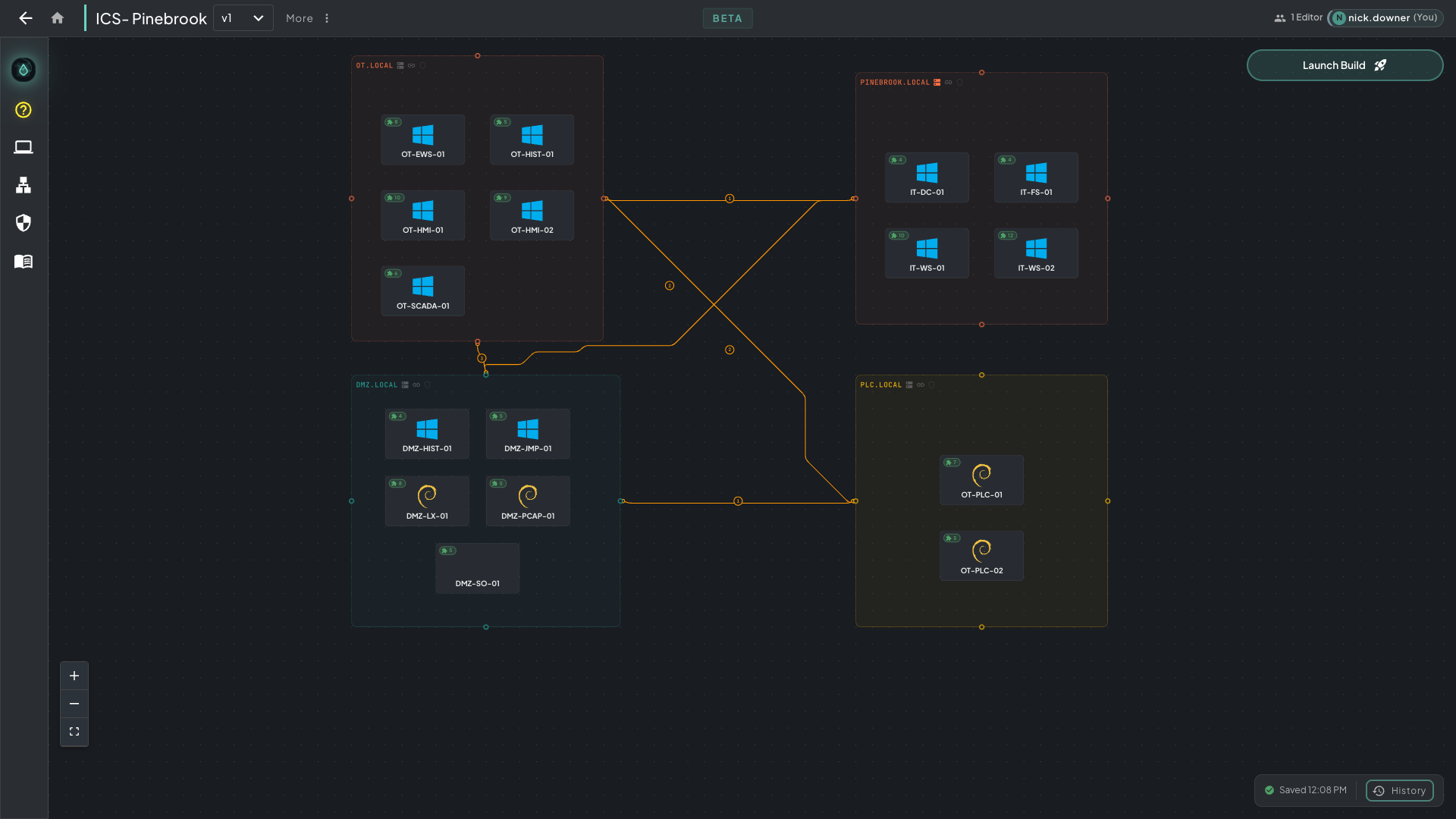 The finished ICS-Pinebrook course canvas — four network segments wired together: the OT floor, the corporate IT domain, a DMZ with Security Onion, and an isolated PLC network.
The Two-Canvas Strategy
Section titled “The Two-Canvas Strategy”Before anything else, the most important architectural decision of this build:
The plugin-testing canvas and the course canvas are completely separate.
One canvas exists purely to validate that every plugin works — exhaustively testing every plugin and parameter combination before they ever touch a student environment. The course canvas is built separately, after the plugins are proven. This distinction matters because debugging plugins inside a live course scenario is painful; debugging them in an isolated test environment is manageable.
Keep these two contexts separate in your head as you read through the phases.
Four Phases
Section titled “Four Phases”Phase 1: Plugins
Research what tooling a real ICS/SCADA course needs, identify catalog gaps, build 14 new plugins, and validate them via a dedicated test canvas.
Plugin developmentPhase 2: Scenario
Feed Claude a course outline, generate a full scenario, validate the flow maps naturally to course objectives, and frame the whole thing as an apprenticeship.
Scenario designPhase 3: Curriculum
AI-drafted curriculum transformed into the instructor's own voice — voice tokens, transform guides, critique agents, and visual learning material.
Curriculum authoringPhase 4: Testing
Claude drives end-to-end testing — deploying VMs, simulating student browser sessions, and executing directly on machines to walk the full lab flow.
Automated testing